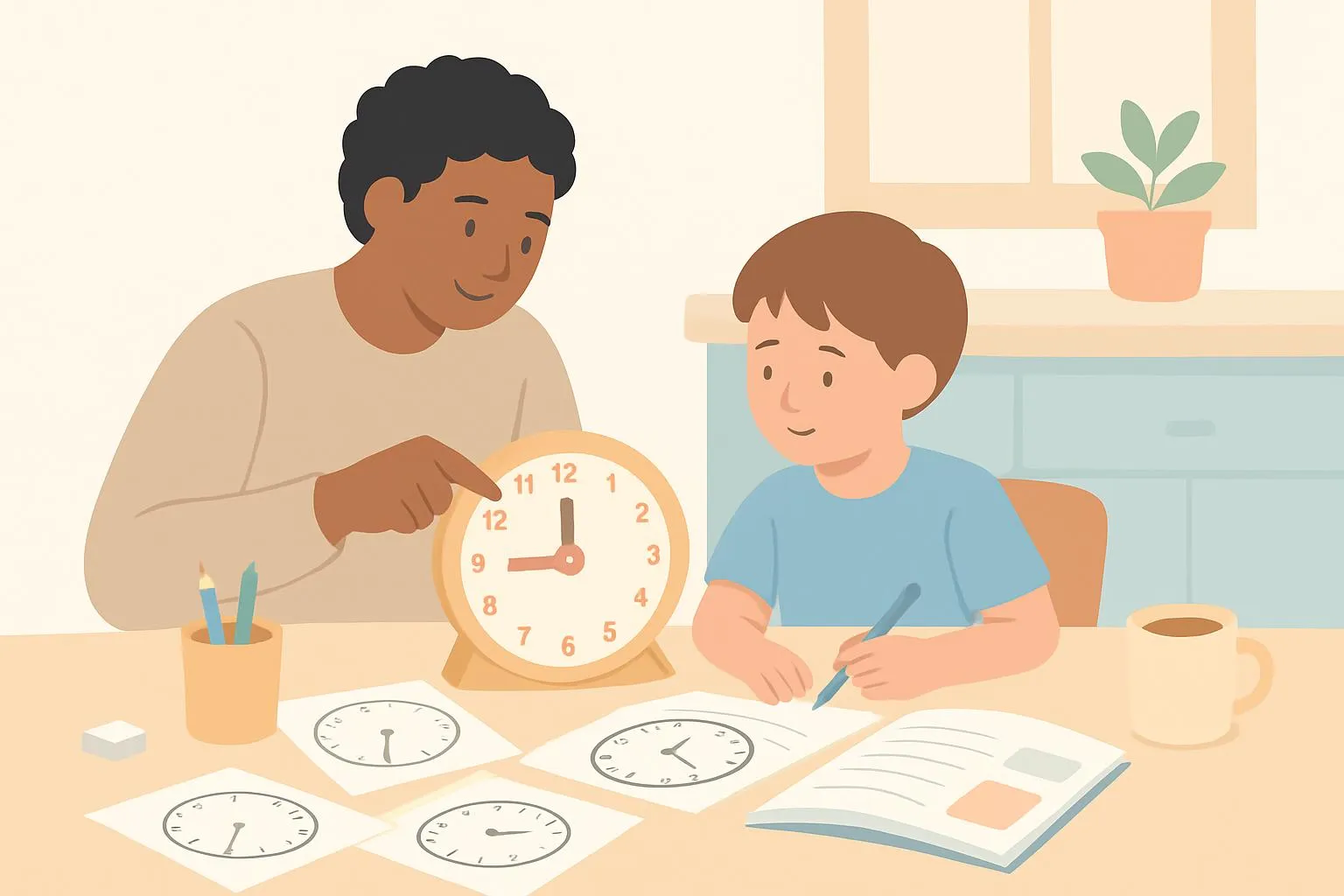
Complete Homeschool Time-Telling Curriculum Guide
Teaching time-telling at home offers unique opportunities for personalized instruction and real-world application. This comprehensive curriculum guide provides homeschool parents with everything needed to teach time-telling effectively, from initial concepts through complete mastery.
Curriculum Overview
Scope and Sequence
Level 1 (Ages 5-6): Time awareness and whole hours
Level 2 (Ages 6-7): Half hours and quarter hours
Level 3 (Ages 7-8): 5-minute intervals and precision
Level 4 (Ages 8+): Elapsed time and advanced concepts
Time Commitment
- Daily Instruction: 15-20 minutes
- Practice Time: 10-15 minutes
- Real-World Application: Throughout the day
- Total Weekly: 2-3 hours formal instruction plus natural integration
Level 1: Time Awareness and Whole Hours (8-12 weeks)
Prerequisites Assessment
Before beginning, ensure your child can:
- ☐ Count to 12
- ☐ Recognize numbers 1-12
- ☐ Understand "before" and "after"
- ☐ Follow simple sequences
Week 1-2: Introduction to Time Concepts
Learning Objectives:
- Understand that time passes
- Recognize clocks in environment
- Learn basic time vocabulary
Activities:
- Day 1-2: Read books about time ("The Grouchy Ladybug," "What Time Is It, Mr. Crocodile?")
- Day 3-4: Clock hunt - find all clocks in your home
- Day 5-6: Discuss daily routine using time words (morning, afternoon, evening)
- Day 7-8: Create picture schedule of daily activities
- Day 9-10: Review and practice time vocabulary
Materials Needed:
- Time-related picture books
- Paper and crayons for schedule
- Photos or drawings of daily activities
Week 3-4: Parts of a Clock
Learning Objectives:
- Identify clock face, numbers, and hands
- Understand purpose of each hand
- Recognize clockwise direction
Daily Lessons:
Lesson 1: Clock Face and Numbers
- Examine analog clock together
- Count numbers 1-12 around the clock
- Discuss circular shape
- Activity: Create paper plate clock with numbers
Lesson 2: Hour Hand
- Introduce short hand
- Explain it shows the hour
- Practice pointing to different hours
- Activity: Move hour hand to different positions
Lesson 3: Minute Hand
- Introduce long hand
- Explain it shows minutes
- Show how it moves faster than hour hand
- Activity: Watch minute hand move for 5 minutes
Lesson 4: Clockwise Movement
- Demonstrate clockwise direction
- Practice moving hands clockwise
- Activity: Walk in circle clockwise, then counterclockwise
Week 5-10: Whole Hours (O'Clock)
Learning Objectives:
- Read times on the hour (1:00, 2:00, etc.)
- Set clock to show whole hours
- Connect times to daily activities
Weekly Structure:
Monday: Introduction and Modeling
- Demonstrate reading 3-4 whole hour times
- Think aloud: "The short hand points to 3, the long hand points to 12, so it's 3 o'clock"
- Practice together with demonstration clock
Tuesday-Wednesday: Guided Practice
- Show various whole hour times
- Child reads each time
- Provide immediate feedback
- Use worksheets from our generator
Thursday: Setting Practice
- Call out times
- Child sets clock to show that time
- Check accuracy together
Friday: Real-World Connection
- Create daily schedule with whole hour times
- Practice reading actual clocks throughout the day
- Games and fun activities
Week 11-12: Level 1 Review and Assessment
Assessment Activities:
- Read 10 different whole hour times
- Set clock to 5 different whole hours
- Match analog clocks to digital times
- Connect times to daily activities
Mastery Criteria: 9 out of 10 correct (90%)
Level 2: Half Hours and Quarter Hours (10-14 weeks)
Week 1-2: Introduction to Minutes
Prerequisite: Child can count by fives to 30
Learning Objectives:
- Understand minute hand function
- Count by fives around clock
- Recognize minute values at each number
Daily Activities:
- Practice skip counting by fives
- Label clock with minute values (5, 10, 15...)
- Point and count around the clock
- Songs and chants for counting by fives
Week 3-6: Half Hours (:30)
Learning Objectives:
- Read times at half past the hour
- Understand "half past" concept
- Notice hour hand position at :30
Teaching Sequence:
Day 1-3: Introduction
- Show minute hand at 6 = 30 minutes
- Count by fives to verify: 5, 10, 15, 20, 25, 30
- Introduce "half past" language
- Show hour hand position (halfway between numbers)
Day 4-10: Practice
- Read various :30 times
- Set clock to show :30 times
- Match analog to digital
- Use worksheets daily
Day 11-15: Mixed Practice
- Combine whole hours and half hours
- Distinguish between :00 and :30
- Real-world applications
Week 7-10: Quarter Hours (:15 and :45)
Learning Objectives:
- Read quarter past (:15)
- Read quarter to (:45)
- Understand quarter/fraction concept
Teaching Strategy:
- Teach :15 first, master it
- Then teach :45
- Practice distinguishing between them
- Optional: "quarter to" language (can be introduced later)
Week 11-14: Level 2 Review and Assessment
Comprehensive Practice:
- All learned times mixed together
- Reading and setting practice
- Real-world problem solving
- Games and activities
Level 3: 5-Minute Intervals and Precision (12-16 weeks)
Prerequisites
- ☐ Mastered whole hours, half hours, quarter hours
- ☐ Can count by fives to 60 automatically
- ☐ Understands hour hand moves gradually
Week 1-8: 5-Minute Intervals
Systematic Approach:
Week 1: :05, :10, :20, :25 (right side of clock)
Week 2: :35, :40, :50, :55 (left side of clock)
Week 3-4: All 5-minute intervals mixed
Week 5-6: Focus on challenging times (:45, :50, :55)
Week 7-8: Comprehensive practice and mastery
Daily Routine:
- 10 minutes: New concept introduction or review
- 10 minutes: Guided practice
- 10 minutes: Independent practice with worksheets
- 5 minutes: Real-world application
Week 9-12: Reading to the Minute
Learning Objectives:
- Read time to exact minute
- Count by fives, then by ones
- Understand minute marks between numbers
Teaching Method:
- Show minute marks between numbers
- Practice: count by fives to nearest number, then by ones
- Start with times just past 5-minute marks (3:16, 3:17)
- Progress to any minute
Week 13-16: Level 3 Review and Assessment
Level 4: Advanced Concepts (8-12 weeks)
AM and PM
Week 1-2:
- Introduce AM (midnight to noon) and PM (noon to midnight)
- Connect to daily activities
- Practice determining AM or PM for various times
- Special cases: 12:00 AM (midnight) and 12:00 PM (noon)
Elapsed Time
Week 3-6:
- Calculate time differences
- Start with whole hour differences
- Progress to half-hour differences
- Eventually include times crossing the hour
Digital Clock Mastery
Week 7-8:
- Read digital times fluently
- Convert between analog and digital
- Understand 24-hour format (optional)
Time Management Skills
Week 9-12:
- Create personal schedules
- Plan activities with time limits
- Use timers and alarms
- Develop time awareness and punctuality
Daily Homeschool Schedule Integration
Morning Routine
- 8:00 AM: "What time is it? Time for breakfast!"
- 8:30 AM: "School starts at 9:00. How long until we start?"
- 9:00 AM: Formal time-telling lesson (15-20 minutes)
Throughout the Day
- Announce time before each activity
- Ask child to check clock and report time
- Set timers for activities
- Discuss duration of activities
Evening Routine
- Review times of day's activities
- Practice with evening schedule
- Set alarm for morning
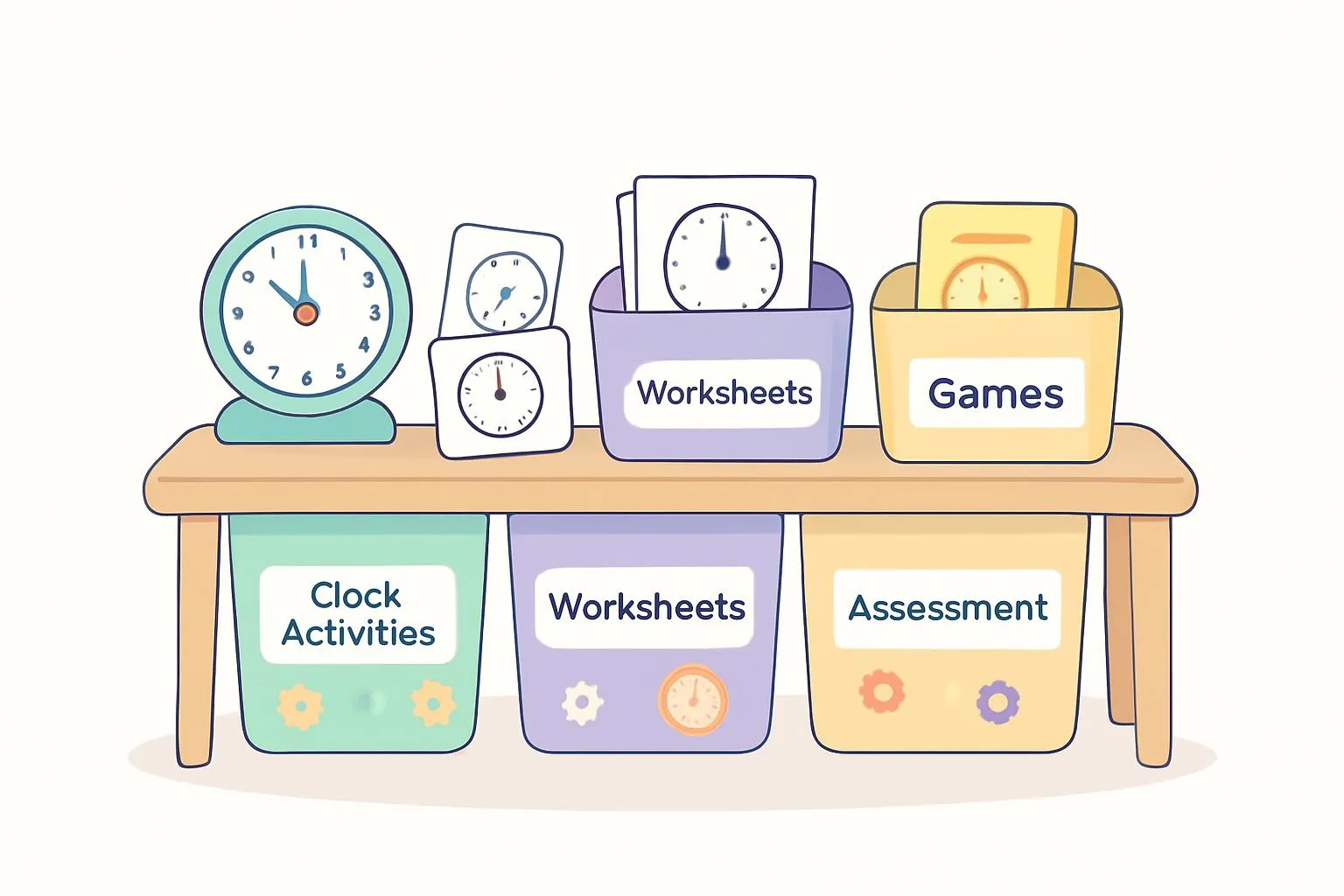
Materials and Resources
Essential Materials
- Demonstration clock: Large clock for teaching ($15-30)
- Student clock: Individual clock for child to manipulate ($5-10)
- Worksheets: Use our free generator (Free!)
- Analog wall clock: Visible reference clock ($10-20)
- Timer: For activities and practice ($5-15)
Recommended Books
- "The Grouchy Ladybug" by Eric Carle
- "What Time Is It, Mr. Crocodile?" by Judy Sierra
- "Telling Time with Big Mama Cat" by Dan Harper
- "Clocks and More Clocks" by Pat Hutchins
Online Resources
- Our worksheet generator (unlimited free worksheets)
- Time-telling apps for tablets
- Educational YouTube videos
- Interactive online clocks
Assessment and Record Keeping
Weekly Assessment
Quick Check (5 minutes):
- Show 5 times at current level
- Child reads each time
- Record accuracy
- Adjust instruction based on results
Level Mastery Assessment
Criteria for Moving to Next Level:
- 90% accuracy on level assessment
- Consistent performance over 2 weeks
- Confidence and fluency
- Ability to apply skills in real situations
Portfolio Documentation
- Save sample worksheets from each level
- Take photos of child with clocks
- Record video of child reading time
- Keep assessment records
- Document real-world applications
Troubleshooting Common Challenges
Challenge: Child Resists Practice
Solutions:
- Keep sessions short (10-15 minutes)
- Use games instead of worksheets
- Connect to child's interests
- Offer choices in activities
- Take breaks when needed
Challenge: Slow Progress
Solutions:
- Extend time at each level
- Check prerequisites are solid
- Increase practice frequency
- Use more hands-on activities
- Be patient—mastery takes time
Challenge: Confusion Between Concepts
Solutions:
- Review previous level
- Use color coding and visual aids
- Practice distinguishing between similar times
- Provide more examples and practice
Adapting for Multiple Children
Different Ages/Levels
- Teach core concept to all together
- Differentiate practice by level
- Older children can help younger ones
- Use multi-level worksheets
Group Activities
- Time-telling games for all levels
- Cooperative learning activities
- Peer teaching opportunities
- Family time challenges
Conclusion: Homeschool Time-Telling Success
Homeschooling offers unique advantages for teaching time-telling: flexible pacing, individualized instruction, and natural integration into daily life. By following this comprehensive curriculum and adapting it to your child's needs, you can ensure time-telling mastery.
Key Success Factors:
- Follow systematic progression
- Practice daily, even briefly
- Integrate into real life constantly
- Be patient with individual pace
- Make learning fun and relevant
- Assess regularly and adjust as needed
Your Homeschool Action Plan:
- Assess your child's current level
- Gather essential materials
- Start at appropriate curriculum level
- Follow daily lesson structure
- Use our free generator for unlimited practice
- Track progress and celebrate success
Recommended Reading
- Parent's Guide to Teaching Time at Home
- Free Printable Clock Resources: Ultimate Collection
- Montessori Approach to Teaching Time
- 📖 Complete Teaching Guide: How to Teach Children to Tell Time
Ready to begin your homeschool time-telling journey? Generate custom worksheets for your child's level with our free tool and start building time-telling skills today!